
The Circular Advantage
Optimizing Resource Productivity through Regenerative System Design

The prevailing global economic paradigm has long been predicated on a “linear” throughput model: Take, Make, Waste. This framework assumes an infinite supply of raw materials and an inexhaustible capacity for ecosystems to sequester industrial externalities. However, as we navigate the fiscal and environmental realities of 2026, it is increasingly evident that the linear model is not merely unsustainable; it is economically unsustainable.
The transition toward a Circular Economy represents a fundamental shift in the management of human-nature relationships. It is the intentional redesign of economic systems to decouple value creation from the consumption of finite resources. According to the Ellen MacArthur Foundation, this transition requires a move from the “consumption” of materials to the “stewardship” of assets across multiple utility lifecycles.
The Structural Fragility of Linear Systems
The linear economy is characterized by significant “value leakage.” When a product reaches its end-of-life and is relegated to a landfill, the system loses the embodied energy, labor, and natural capital utilized in its production. In the context of Sustainability Economics, waste is defined as a primitive design flaw—a failure to maintain the highest utility and value of components at all times.
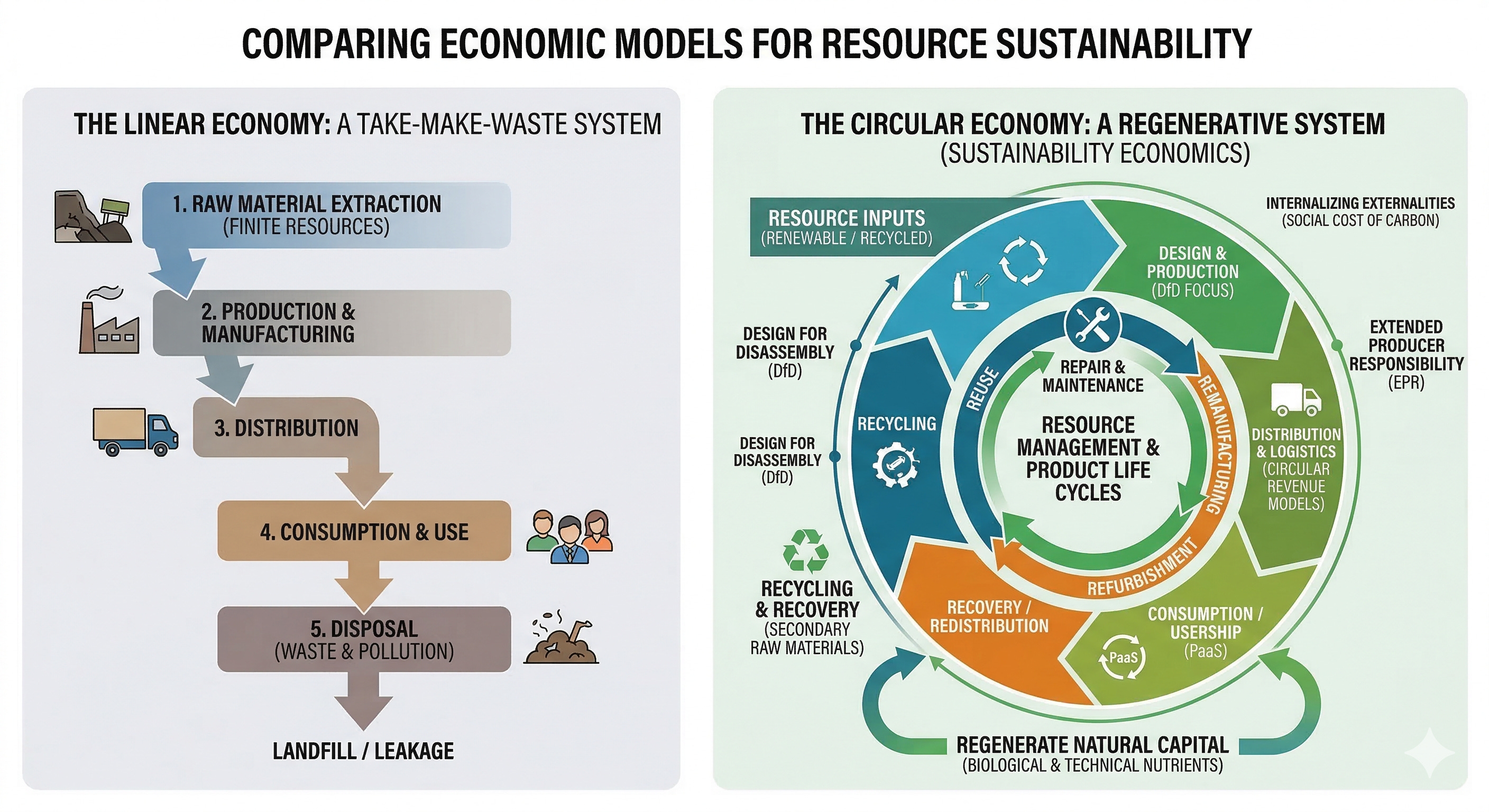
Furthermore, linear supply chains are acutely vulnerable to geopolitical volatility and resource scarcity. By internalizing these externalities and adopting circularity, firms can mitigate systemic risks that traditional accounting methods often overlook.
Theoretical Pillars of Circularity
To optimize the Return on Investment (ROI) of circularity, organizations must implement three core principles, as outlined by the Green Economy Coalition:
Elimination of Waste and Pollution via Design: Value retention begins at the conceptual stage. By utilizing Design for Disassembly (DfD), manufacturers ensure that technical nutrients can be recovered and reintegrated into production cycles without loss of quality.
Circulation of Products and Materials: This involves shifting from “ownership” models to “access” models, such as Product-as-a-Service (PaaS). Under PaaS, the producer retains the asset, incentivizing the development of durable, repairable, and upgradable goods.
Regeneration of Natural Capital: Unlike the linear model, which degrades the environment, circularity seeks to rebuild ecosystem services. This ensures the long-term viability of the biological nutrients that underpin global commodity markets.
The Economic Imperative: 2026 and Beyond
The “Circular Advantage” has transitioned from a corporate social responsibility (CSR) metric to a core fiduciary requirement. Several drivers are accelerating this shift:
1. Strategic Resource Resilience - Recent research in the MDPI Journal of Sustainability demonstrates that circular strategies—specifically remanufacturing and secondary material harvesting—act as a hedge against supply chain disruptions. By establishing “closed-loop” systems, firms reduce their exposure to the price volatility of primary raw materials.
2. Regulatory Evolution: The 2026 Mandate - The regulatory landscape is undergoing a period of rapid professionalization. The EU Circular Economy Act, entering its implementation phase in 2026, introduces the Digital Product Passport. This mandate requires transparent data on material provenance and end-of-life pathways, effectively making linear production a high-risk compliance liability.
3. Macroeconomic Opportunity Cost - The World Economic Forum projects that the circular transition could yield a $4.5 trillion increase in global economic output by 2030. This growth is driven by the expansion of the “maintenance, repair, and operations” (MRO) sector and the emergence of sophisticated markets for secondary feedstocks.
Re-quantifying Success
The transition to circular economics necessitates a re-evaluation of Key Performance Indicators (KPIs). The traditional focus on “Total Units Sold” is being supplanted by Circular Revenue—a metric that tracks income generated from refurbished assets and recycled inputs.
As we progress through 2026, the distinction between environmental stewardship and economic optimization will continue to dissolve. The future belongs to the “non-wasteful”—those organizations capable of managing resources with the same rigor they apply to capital. The central question for modern leadership is no longer a matter of ethics, but of endurance: In a resource-constrained world, can your business model survive the end of the linear era?